Peugeot GT10 · 1972

My Peugeot GT10 › Transmission guide · GT10 and 103 SP

Transmission guide · GT10 and 103 SP

Tuning a Doppler ER3 variator on a Peugeot GT10

Easy to set up but not optimised out of the box: here is, step by step, how I made the Doppler ER3 use its full range on my 1972 Peugeot GT10.

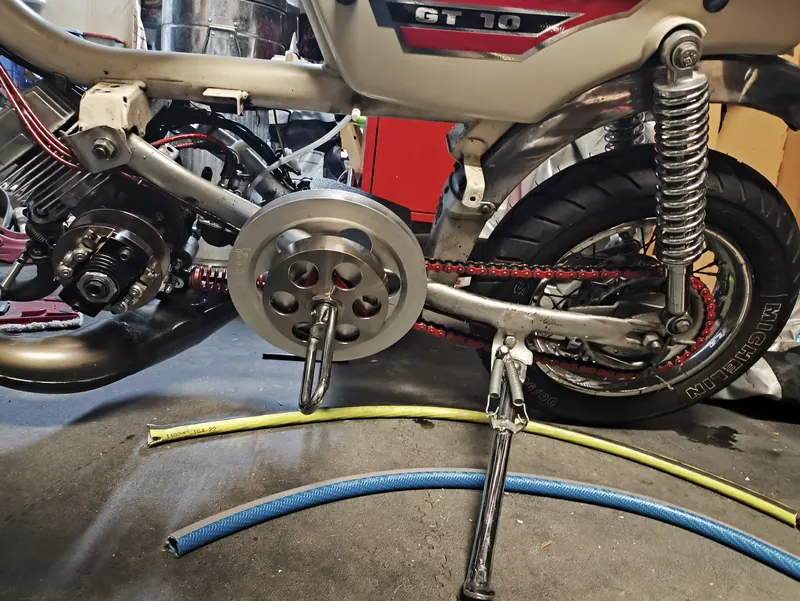
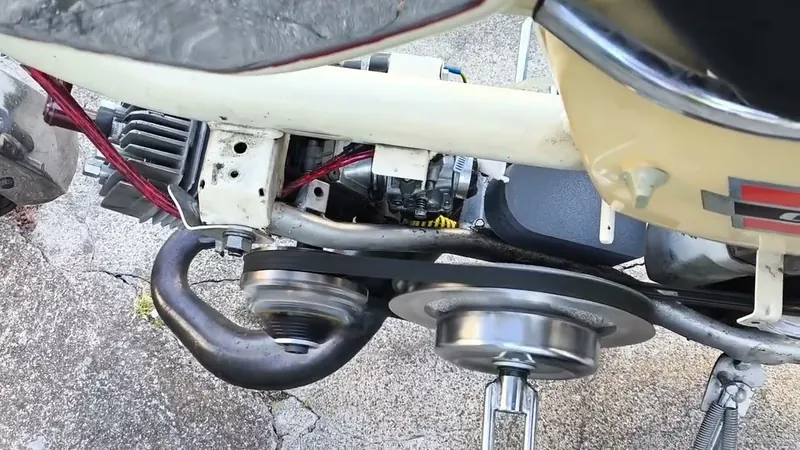
The GT10's transmission: Omega clutch pulley, red chain and rear wheel

Why the Doppler ER3

The starting point

Before the Doppler, I ran a Malossi Variotop long-range variator. I never managed to get it to use its whole range. The Doppler ER3 is much easier to set up, but it is not optimised out of the box: at rest the belt does not sit low enough, and at full throttle it does not climb all the way to the top.

This guide goes through, in order, what I did on my 1972 GT10 to use the full range. The GT10 shares its engine and transmission with the Peugeot 103 SP, so the method also applies to a 103 or a similar setup.

A little throwback: I had already tried fitting an ER3 back in 2011. The belt was floating, because it is a long-range variator, and I had to cut the engine mount again. This time, every millimetre is dialled in.

My setup

Current transmission

Variator
Doppler ER3
Weights
CBE, heaviest available
Clutch
Machined Omega Revo pulley
Belt
Malossi 617233 · 15x8x853 · 32°
Gearing
13 x 38
Spring
Doppler red or yellow
Engine
Shifted 4 mm to the left

The steps

In the order I did them

Enlarge the sleeve so the belt sits as low as possible

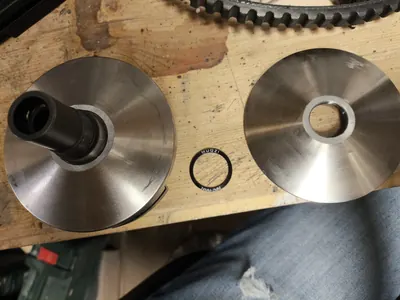
I add a 2 mm washer on the sleeve and open up the bore of the pulley face. At rest, the belt now sits as close to the sleeve as possible, without touching it.

That is what gives the best take-off: you start on the smallest possible diameter.

The Doppler ER3 variator faces and sleeve, with the 2 mm washer
The pulley faces, the sleeve and the 2 mm washer.

Lightly grind the faces so the belt climbs to the top

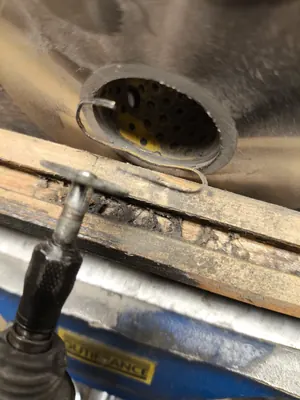
Out of the box, the belt does not reach the top of the faces at full throttle. A light sanding of the bore fixes that.

I work in small passes and check often: better to remove too little than too much.

Sanding the bore of a Doppler ER3 pulley face with an abrasive drum
Sanding the bore of the pulley face.

Line up the engine with the pulley

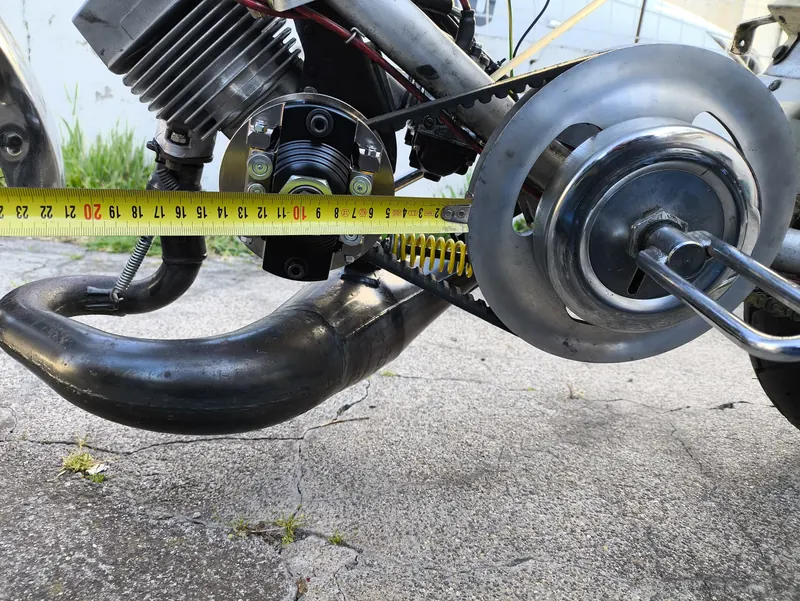
On my GT10, I had to shift the engine 4 mm to the left for the belt to be perfectly in line with the clutch pulley.

I check it with a tape measure along the belt: poor alignment wears the belt and costs you range.

Tape measure laid along the belt to check the alignment
Checking the alignment, still with the Doppler ER2 pulley.

Lengthen the gearing with a machined Omega pulley

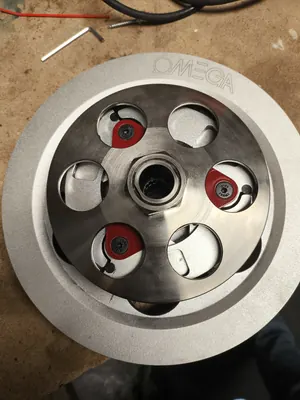
With 10-inch wheels, the GT10 revs out quickly. I swapped an 11-tooth Doppler ER2 clutch for an Omega Revo clutch pulley that takes a 13-tooth sprocket: the gearing goes from 11x38 to 13x38.

When it arrived, a machinist cut the pulley to 32° to take the 15 mm Malossi belt (ref. 617233, 15x8x853).

The Omega clutch pulley machined for the 15 mm Malossi belt
The Omega pulley, machined to 32°.

Pick heavy weights

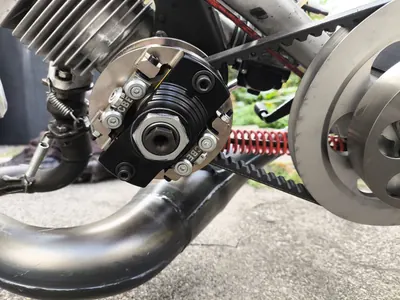
To stop the engine from revving too high, I replaced the stock Doppler ER3 weights with better-quality CBE ones, at the heaviest weight available.

The Doppler ER3 variator fitted with its CBE weights and the red spring
The variator in place, with the CBE weights.

Test the tension spring

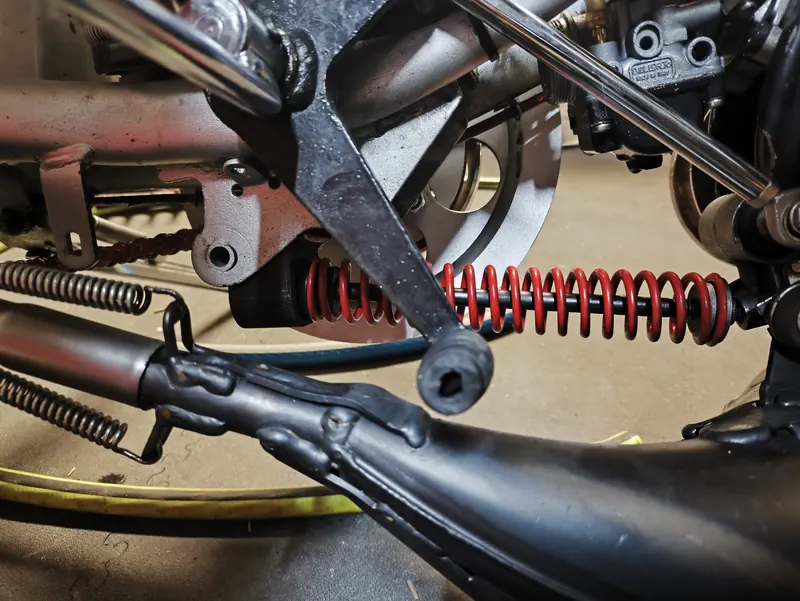
I am testing the red or the yellow Doppler spring depending on the trial. It bears directly on the centre stand pivot thanks to a part I designed and 3D-printed in PETG: no welding and no extra bolt on that side.

It is still a prototype, but every test so far has been conclusive.

The red Doppler spring bearing on the stand pivot thanks to a PETG part
The red spring and its PETG part.

The test video

Set-up validated off load

Video thumbnail: the GT10's transmission, Doppler ER3 variator and belt16 s Oct. 2026Doppler ER3 test: the full rangeSet-up validated off load: the belt climbs right to the top of the variator.Watch on YouTube ↗

The test, engine running and nobody on the moped: the belt climbs right to the top of the variator. The set-up is validated off load.

What remains is to confirm it on the road, with tests under load.

Where it stands

And what comes next

Where I am

  • With nobody on it, the variator's full range is finally used.
  • On the road, the variator still only uses about two thirds of its travel: there is room left.
  • Tests under load are still to come, especially to choose between the red and the yellow spring.

Tips from the Mob_Kustom group

  • A stiffer spring will make the variator climb even less.
  • Make the variator heavier, i.e. play with the weights.
  • Test without the spring first, to watch how the engine pivots.