GT 10
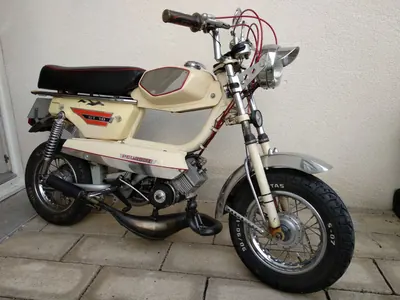
The original GT10, with a variator and no indicators.
My Peugeot GT10 › History · 1972 to 1978
History · 1972 to 1978
10-inch wheels, the engine of the 103 and the look of a mini motorbike: the Peugeot GT10 was one of the first French mini mopeds. Here are its key dates, its versions and its original specifications.
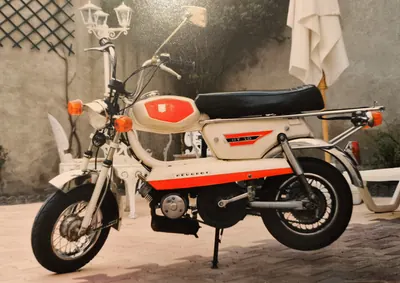
The 103, scaled down
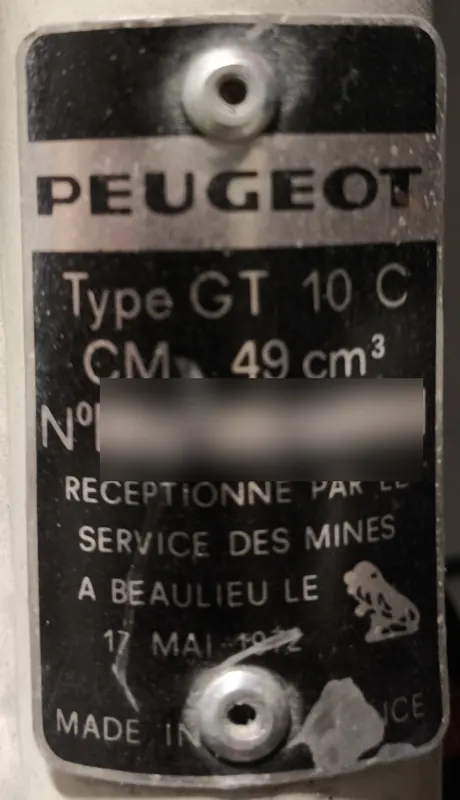
The Peugeot GT10, spelled "GT 10" in the catalogue, is a 49.9 cc moped built by Peugeot at its Mandeure factory, in the Doubs region of eastern France. It appeared in the early 1970s: in 1972 according to Wikipedia, in 1973 according to other enthusiast sources. My own GT10, a GT 10 C, dates from 1972.
The idea is simple: take the proven engine and transmission of the Peugeot 103 and fit them into a tiny frame, perched on 10-inch wheels. The result looks like a mini motorbike, with its two-up seat, chrome rims and extendable luggage rack.
At the time, mini mopeds were still very rare in France. The GT10 was the odd one out in the Peugeot range, and it cost more than a regular 103, which was more versatile and more comfortable.
It left the catalogue in 1978. The GL 10, its cheaper little sister, took over until 1980.
The GT10 also had its famous riders: archive footage broadcast by France 3 shows the French actor Jacques Villeret riding one down a Paris street.
From 1972 to 1980
Peugeot launches the GT10 at its Mandeure factory and adds it to the catalogue (1973 according to some sources).
The Formule 3 arrives, the version with a 3-speed gearbox, built until 1977 according to enthusiasts.
At the end of the year, the GT10 C phase 2 moves its front indicators above the headlight. It remains rare.
Launch of the GL 10, a simpler and more affordable version.
The GT10 leaves the Peugeot catalogue after a career of about five years.
End of production of the GL 10, which closes the line.
Three GT10s and a little sister
The original GT10, with a variator and no indicators.
The same GT10, fitted with indicators. This is the version of my GT10, as shown on its maker's plate. At the end of 1975, the phase 2 moved the front indicators above the headlight: it is rare, and its original parts are hard to find.
The version with a 3-speed gearbox instead of the variator. According to enthusiasts, it uses the gearbox of the 104 Formule 3 and the Rallye, with a foot shifter, and around 3,000 were built. These details are not officially confirmed.
A cheaper evolution of the GT10, with a simpler, scooter-like style. The engine and transmission stay the same.
Variator version
Original specifications
These figures come from spec sheets published by enthusiasts. They sometimes vary slightly from one source to another: the displacement, for example, is given as 49 or 49.9 cc.
The Formule 3 replaces the variator with a 3-speed gearbox.
The 1976 spare parts catalogue lists all the original part numbers, and the tyre pressures are printed on a sticker inside the storage box: both are on the documentation page.
What you need to know
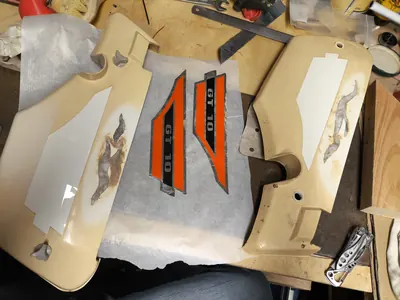
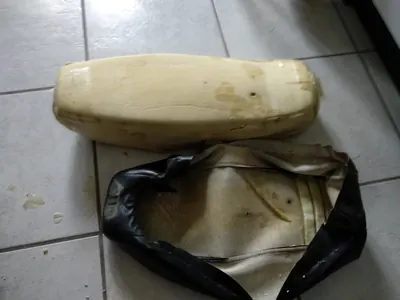
The GT10 has become a collectible moped, and its value keeps rising. The good news: its 103 engine and transmission parts are still easy to find. Parts specific to the GT10, on the other hand, are rare, especially the bodywork (mainly the two storage box panels) and the decals.
Eventually, I would like to recreate those panels with 3D printing, as I have already done for several small parts of my GT10.
For the fork, the springs and the decals, JayJay, an enthusiast from the community, has had the impossible-to-find parts remade. And Antony, who created the Peugeot GT10 Facebook group, restores GT10s.
Don't expect much comfort: with its small wheels and short suspension, the GT10 does not like bumpy roads. In town, however, it is lively and very nimble.
Mine came out of a cellar in the early 2000s. Its whole story, from restoration to tuning, is told year by year on the home page.
The NOIL retrofit
Converting the GT10 to electric should soon be possible thanks to NOIL, a French company specialising in retrofitting: turning a petrol two-wheeler into an electric one, with a type-approved kit and an updated registration certificate.
NOIL already converts the Peugeot 101, 102, 103, 104 and 105 mopeds, and its 103 kit is also sold through the Peugeot Motocycles dealer network. The kit for the GT10 and the GL 10 is currently available for pre-order on its website: it is not on sale yet.
On the 103, it works like this: an electric motor replaces the petrol engine, and a removable battery fits on the luggage rack. A partner garage does the fitting, and the registration certificate is changed to electric power (the "EL" entry).
Further reading